The Missing Layer of Financial Security
Financial Security, Family Money, Protection Layer
Your Family Did Everything Right. Here Is the One Layer of Financial Security Nobody Taught You.
You pay your bills on time. You have a savings account. You meal prep on Sundays to save money. You comparison shop. You use coupons. You drive the paid-off car instead of financing the new one.
And you still feel one medical bill, one car repair, one layoff away from losing everything you built.
You are not bad with money.
You were never given the full picture.
If that sentence hits you in the chest, keep reading. Because this post is not about what you are doing wrong. It is about the one layer of financial security that was never taught to you — and why it changes everything once you have it.
Why Doing Everything Right Still Feels Like It Is Not Enough
Here is the truth nobody says out loud: the financial education most families received was incomplete. It covered the basics, save more, spend less, make a budget. And those basics matter. But they are the floor of a building that has no walls.
A budget tells you where your money goes. It does not tell you what happens when the money stops coming. An emergency fund of one thousand dollars feels like progress, until the car repair costs fourteen hundred. A credit score feels like safety, until you realize it measures how profitable you are to lenders, not how financially healthy you are.
The layer that is missing is protection.
Not budgeting. Not saving. Not investing. Protection, the shield that keeps your budget from collapsing when life does what life does.
And this is not your fault. Only six states in America require both economics and personal finance to graduate high school. That means your teen can earn a diploma without ever learning what a deductible is, how compound interest works against them, or what happens when they sign a lease they cannot afford.
Nobody taught your parents this. So, nobody could teach you. nless something changes, the cycle repeats with your children.
This is not a character flaw. This is a system failure. And it is fixable.
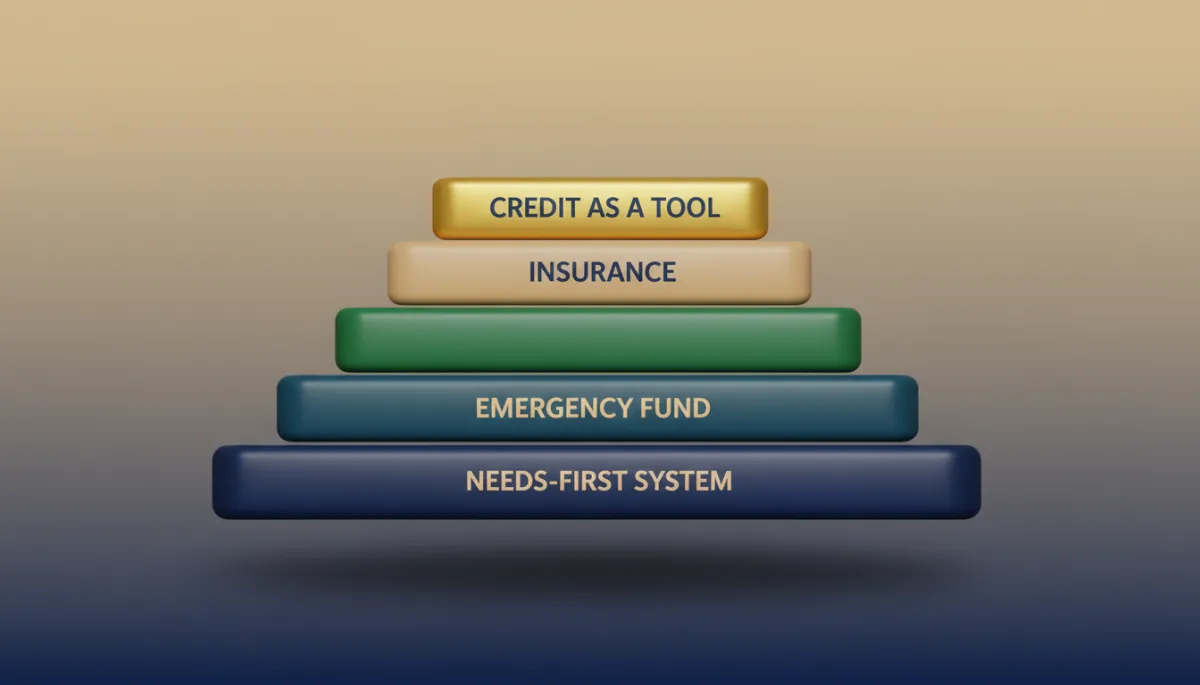
Treat your money like a system: build layers so one failure does not crash everything.
What a Financially Protected Family Actually Looks Like
Picture this.
Your car breaks down on a Tuesday. You do not panic. You do not move money from one account to another. You do not put it on a credit card. You open the emergency fund, cover the repair, and start rebuilding the fund on Friday. Life continues.
Your teen gets their first apartment. They read the lease before signing it. They set up renters' insurance for twenty dollars a month. They know exactly how much they need to earn to cover their needs. They have an emergency fund started, small, but started. They do not sign up for the first credit card offer that comes in the mail.
Your family sits down once a month, not to stress about money, but to check the system. Needs are covered. Savings is growing. Wants are guilt-free because the foundation is solid.
That is not a fantasy. That is what happens when the protection layer is in place.
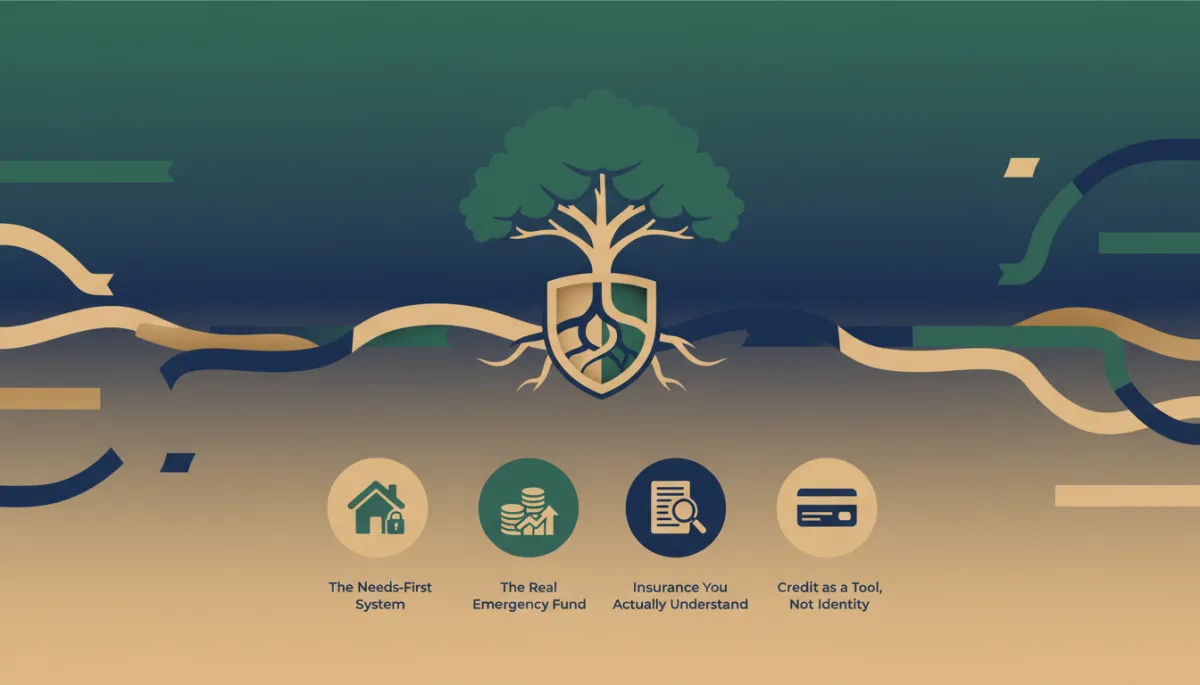
The Protection Layer Has Four Parts
Part 1: The Needs-First System.
Every dollar follows one order: needs first, then save, then wants. Not a budget that requires daily willpower. A system that runs every paycheck, every time, no decision required. Housing, food, utilities, insurance, transportation, minimum debt payments — those come first. Then savings. Then — and only then — wants. This is the order that holds when life gets hard.
Part 2: The Real Emergency Fund.
Everyone says save one thousand dollars. That is the starter. The real target is three to six months of your needs — not your income, your needs. Add up housing, food, utilities, insurance, transportation, and minimum payments. Multiply by three. That is your emergency fund goal. Start with what you have. Build from there. But know the real number.
Part 3: Insurance You Actually Understand. Most families pay for insurance they have never read. They do not know their deductible. They do not know what their liability limits mean. They do not know whether their coverage actually matches what they drive, where they live, or who depends on them. The protection layer includes reading your policies, understanding what they cover and what they do not, and making sure the coverage matches your actual life — not the life you had when you signed up three years ago.
Part 4: Credit as a Tool, Not an Identity. A credit score is not a measure of wealth. It is a measure of how profitable you are to lenders. The financially protected family builds credit without carrying debt. One recurring bill on a credit card, paid in full every month. No balance carried. No interest paid. The score goes up because you are reliable — not because you are borrowing.
These four parts together are the layer. The budget is the floor. This is the walls, the roof, and the lock on the door.
def emergency_fund_goal(monthly_needs, months=3):
    """
    monthly_needs: housing + food + utilities + insurance +
                   transportation + minimum debt
    months: target coverage window (3-6 months)
    """
    return monthly_needs * months

monthly_needs = 2400  # example
goal = emergency_fund_goal(monthly_needs, months=3)
print(f"Emergency fund target: ${goal:,.2f}")
You do not have to hit the full number tomorrow. But you deserve to know the real number and steadily iterate toward it, the same way you would refactor a legacy system over time instead of rewriting it in one sprint.
Part 3: Insurance You Actually Understand (Reading the Config)
Most families treat insurance like a mysterious third-party library: “It was installed once; I hope it works.” Insurance understanding means you have actually read your “config files”—auto, health, renters, life—and you know your deductibles, limits, and exclusions.
Set aside an evening to “debug” your coverage:
List each policy and its deductible (what you pay first).
Note liability limits (what the company pays if you hurt someone or damage property).
Check if the coverage still matches your current life—your car, income, dependents, and location.
Once you understand it, you can adjust it. That is how insurance turns from a mysterious bill into part of your protection layer.
Part 4: Credit as a Tool, Not Your Identity
A credit score is not a wealth metric; it is a lender’s reliability metric. Treating it like your financial identity is like judging a codebase only by its test coverage percentage. Useful, but incomplete—and dangerous if you optimize only that number.
def use_credit_as_tool(bill_amount):
    """
    Simulate using a credit card for one recurring bill
    and paying it off in full.
    """
    credit_card_balance = 0

    # charge recurring bill
    credit_card_balance += bill_amount

    # pay statement in full
    payment = credit_card_balance
    credit_card_balance -= payment

    return credit_card_balance  # should be 0
Using credit this way builds a positive history without carrying balances or paying interest. The score rises because you are reliable, not because you are permanently in debt.
Financial Education: Shipping This Knowledge to the Next Generation
Only a handful of states require real financial education. That means most teens graduate knowing how to solve for X, but not how to read a lease, compare bank accounts, or calculate the cost of interest. In engineering terms, we are sending them to production with zero onboarding and no documentation.
Programs like Financially Growing change that. Middle schoolers who started without knowing what a SMART goal was finished with budgets, researched financial institutions, and over 50% more confidence making money decisions. High schoolers asked for more time learning about money, not less. The demand is there. The missing piece is access.
Your Next Step: Add the Protection Layer to Your Family’s Stack
You and your family have already done so much right. Now you can add the missing layer that makes all that effort hold under stress: a clear needs-first system, a real emergency fund target, insurance you understand, and credit used as a tool. That is the architecture of financial security, not just survival.
If you want a guided path, start with the free resources at financiallygrowing.com, explore the MoneyRoots tools for your teens, or bring Financially Growing into your school or organization. The discovery call takes thirty minutes. The protection layer you build with your kids can last their entire lives.
Financial growth is not about perfection. It is about direction—and today, you can choose to point your family toward a future where one bill, one repair, or one layoff does not take everything down with it.